

One of a leader’s most important jobs is to get and stay clear about what it is that s/he is counting on from each team member. Once the leader is clear, the message must be communicated to each team member. Often, leaders fail to engage in a rich communication along these lines, apparently because they assume that team members are somehow supposed to figure out for themselves exactly what is expected.
The steps presented in the slides available by clicking the above icon and in the following text make explicit a conversation that otherwise plays-out inside of the heads of those involved. When the conversation is explicit the leader and team member get on the same page and dramatically increase the odds of high-performance and fulfilled expectations.
Contract:
The leader first gets clear about what is needed from each person on the team. For each team member, the leader sets up a one-on-one conversation to relate exactly what the team is counting on from him/her. The leader should be certain that what is said is really what is wanted and that s/he thinks the person is able to do what it is the group requires; and then ask the person to repeat back what they were told to be sure s/he has it right; and then ask to verify s/he really does want to do it and that s/he believes s/he has the ability do it.
Once there is agreement between the leader and the team member on what, want, and ability, then there is essentially a verbal contract for the team member to do what is asked. The leader then must ensure that the team member has the resources (such as: time, training, people, money, texts, and advisers) needed for success.
Finally, the leader must make it worth the team members while to succeed such as by providing praise, a bonus, a promotion, or a trip upon successful completion.
In summary:
- Get clear about who is to do what.
- Tell each person what the team counts on him/her to do; do not assume that just because the leader said it that s/he “gets it.
- Ask him/her to repeat back what was heard to verify it is what is intended.
- Express confidence that s/he can do what is asked.
- Verify that s/he too believes s/he can do what is asked. There is no point in asking someone to do something s/he does not believe s/he can do. Paraphrasing Henry Ford: “if they think they can or if they think they can’t…they are probably right!”
- Tell him/her that you really want him/her to do what you ask.
- Verify that s/he indeed wants to do it. People often want to do something other than what they like doing and what they are good at doing because they think others value something other than what they are good at and like doing. The leader’s job is to make clear that what the team member is good at and likes doing is indeed what is wanted.
- Write down what has been agreed to in a performance plan complete with what you will track to know how things are going and to know when what is to be done is indeed done.
-
- Time
- Space
- Training
- Experience
- Money
- People
- Advice
- Feedback
-
- Recognition
- Experience
- Resume enhancement
- Admiration
- Praise
- Prominence
- Attention
- Bonus
- Trip
- Award
- Dinner
- Raise
- Promotion
The following graphic presents a way to visualize the steps outlined:
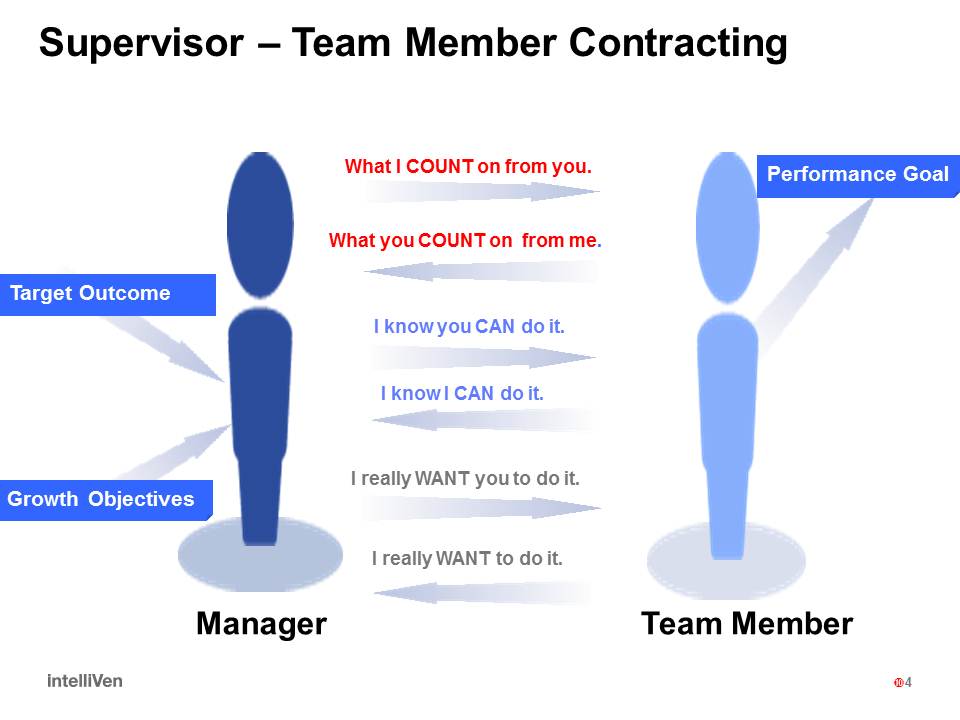
Remember that delegation is not the same thing as abdication and that the number-one reason things go wrong is lack of management attention. The wise leader checks-in from time to time to be sure front-line action is proceeding as expected. Go out of the way to make it clear that you are on his/her team and that your only interest is success. Give something tangible to manifest your commitment such as your best thinking in the form of notes or drawings, key insights or ideas and invite your direct report to internalize your input and take it further as though it were their own.
- Last period’s priorities and progress with metrics to support claims of progress; the leader’s mindset is to ask: how is it going; how do you know?
- List and talk through the top three to five, but no more, priority items fully to cover: what is going on and how it is going. The leader should go out of his/her way to be supportive, on the same team as the direct report and to help by providing resources, training, head start, access to other people, etc.
- Agree on top items, next steps, what is to be done next and what the leader will do to help.
The leader also prepares and presents to the team member in less than 15 minutes:
- His/her top three to five priorities to be kept honest; to let the team member in on something special and on what the leader is doing for the good of the team; and it is good for the leader to consolidate and share such information.
- The leader discusses points raised until it is certain that they are clear and then solicits input and advice.The leader commits to follow up to keep the team member aware of what the leader is doing as desired.
- The leader commits to follow up to keep the team member aware of what the leader is doing as desired.
The following presents a way to visualize the steps outlined above:

Failure to follow the governing steps above is a recipe for calamity!
Note: The content in this post is from the Get Aligned chapter in Manage to Lead: Seven Truths to Help You Change the World.