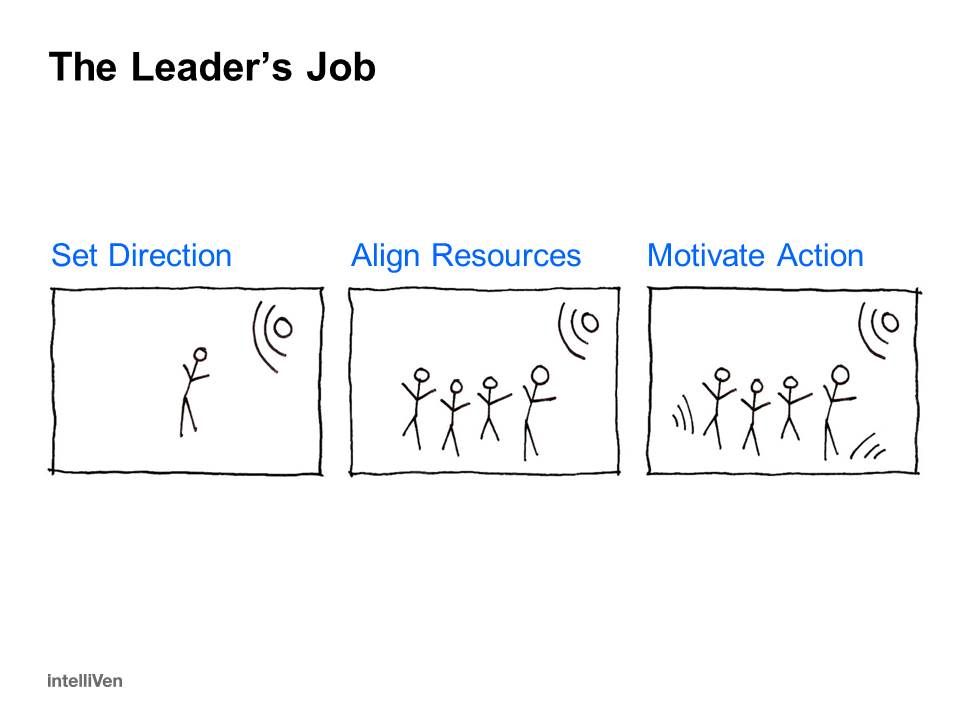
Leaders set direction, align resources, and motivate action as suggested by the panels in Figure 1. Another way to put it is that a leader develops, holds, nurtures, communicates, and drives to achieve a vision.
Figure 1: A leader sets direction, aligns resources, and motivates action.
As in Figure 2, it helps to think of the leader holding a map, like Harry Potter’s Marauder’s map that is always changing, making sense of it, and navigating the course with those led looking on over the shoulders. The best leaders constantly check with their top team to confirm that they are headed toward the same goals, in the same way, and for the same reasons.
Figure 2: A leader develops, holds, nurtures, communicates, and drives to achieve a vision.
As suggested by the illustration in Figure 1, a leader:
Sets direction represented in the first panel by the target with a bull’s-eye in the middle.
Aligns resources; that is, the leader collects followers who all look to hit the same target.
Motivates action, as suggested by the radio bars in the lower corners of the third figure, which causes the resources to progress towards the target.
Figure 1: A leader sets direction, aligns resources, and motivates action.
Another way to say it, as summarized in Figure 2, is that a leader develops, holds, nurtures, communicates, and drives to achieve a vision. Like Harry Potter’s Marauder’s map, the leader holds a map that is always changing, making sense of it, and navigating the course accordingly with the team looking over his/her shoulder. Continue reading How to decide what kind of leader to be.→
Many intelliven.com blog posts are based on the slides and lecture notes from a masters class in Organization Development called Organization Analysis and Strategy offered at American University and taught by Peter DiGiammarino. These posts and other material from class, including:
Work problems,
Templates,
Graphics,
Slide shows, and
Assessments
are available from Amazon as a softcover workbook or from iTunes as an iBook titledManage to Lead: Seven Truths to Help You Change the World.
Selected intelliven.com blog content is now available as a workbook from Amazon or as an iBook from iTunes.
Whether one wants to change personal habits, implement a new information system, improve a business process, get team members to work together, increase a community’s appreciation for diversity, or even to topple a monarchy, taking seven actions driven by seven disarmingly simple truths will individually and collectively help achieve the goal.
Manage to Lead presents a framework to describe and assess any organization. It also provides a structured approach to plan and implement next steps for an organization as it strives for long-term growth and performance.
Readers are invited to select a familiar organization on which to apply the tools and templates introduced throughout the workbook. Exercises in each chapter produce essential elements for the organization’s annual strategic plan and lay the groundwork for implementing that plan.
Readers can package the key elements from Organization Exercises to form a strategic plan that communicates how the organization sees itself and where it is headed. At the end of the year leaders can compare actual results with what was described in the strategic plan to study what happened, why what happened was different than plan, what is to be learned from that, and what to do differently going forward as a result.
Repeat the process over several years and compare actual to planned results year-to-year to see the organization mature, perform, and grow to its full potential.
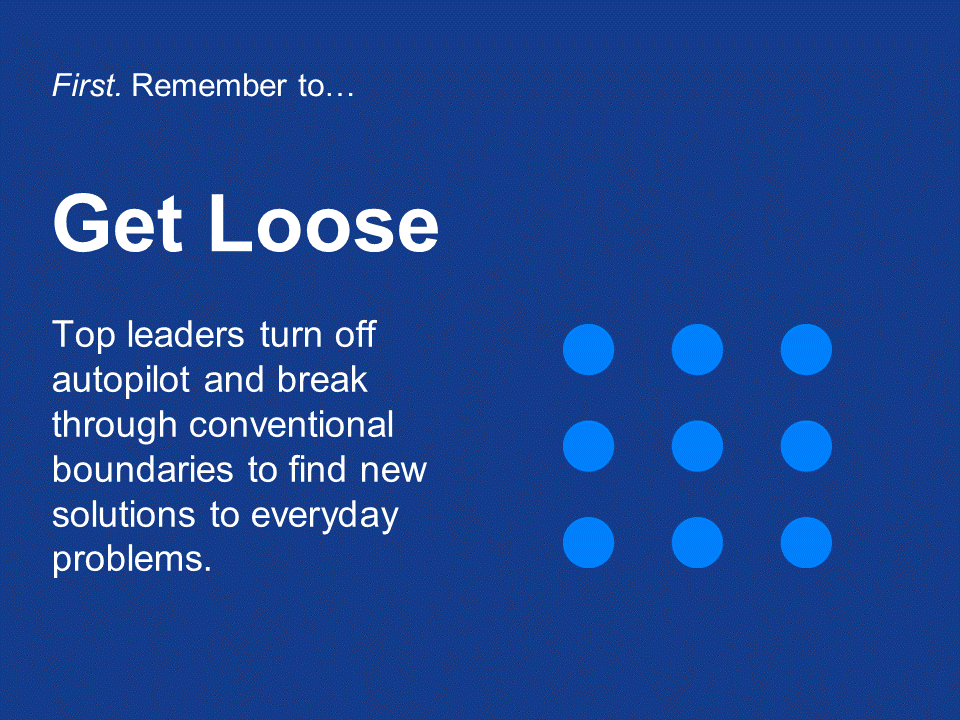
Most people find it is hard to connect all nine dots in the figure at left with four straight lines, without retracing any lines, and without lifting their writing implement.
The reason it is hard to do is because in order to solve the puzzle a person has to think and operate in ways that are different than normal; or outside the box, as they say.